Two personas, one funnel: how Nomad Education converts the parents who pay for their kids’ tutoring

- TL;DR
At Nomad Education, students use the app but parents pay for it. Growth Manager Laetitia Barre explains how a share-to-parent button on student paywalls, a parent free trial with a 7-day onboarding, and a new Web2App flow lifted conversion, with 60% parent retention, and why the team times promotions to the school calendar instead of Black Friday.
Nomad Education launched 15 years ago as a 100% free, ad-funded study and career guidance app, built for young people from elementary school to college.
Its main challenge is one every app used by minors knows: the student is the primary user, but the parent is the subscriber, and they’re rarely in front of the same screen.
This article looks at how Nomad closed that gap, and at what its first Web2App flow is already teaching the team.
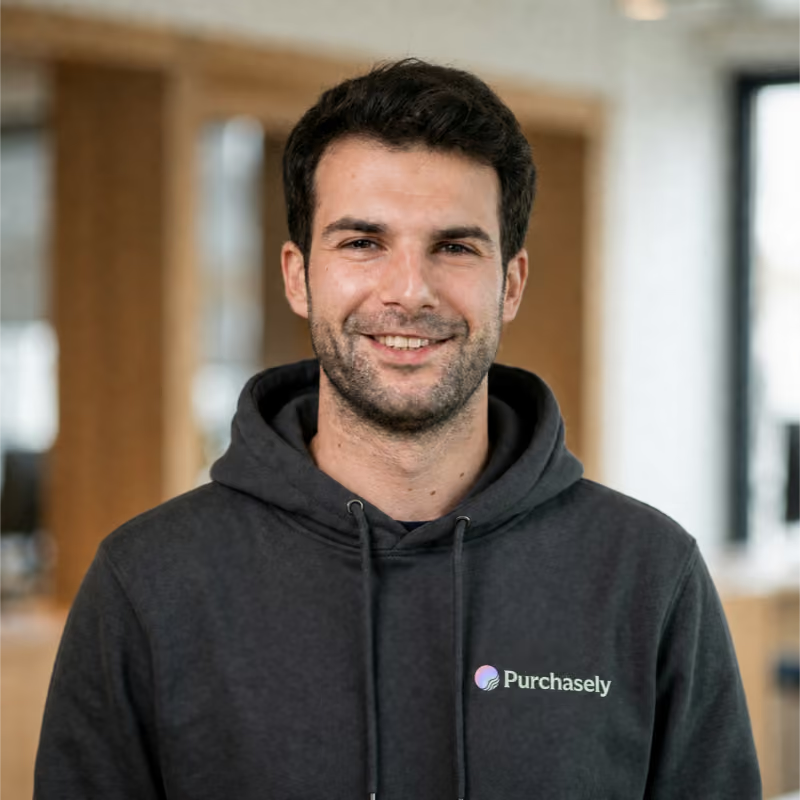
To understand how it works, we spoke with Laetitia Barre, Growth Manager at Nomad Education. She first shared these lessons on stage at Converted, our first event in Paris, held on October 22 at Snap’s office with Snapchat Planets and Scalebay.
This interview first appeared in App Stories, our monthly newsletter with growth and product leads from subscription apps. Subscribe here to get the next one.
From a free, ad-funded app to a subscription business
Camille from Purchasely: Where is Nomad used today, and by how many people?
Laetitia Barre: Nomad is available on mobile and desktop, all over the world. Our core markets are francophone: we have more than 1 million users across France, Belgium, Switzerland and more than 20 African countries.
What does the subscription add to the free app?
L.B.: About five years ago, we launched Nomad+, our premium offer on top of the free app. The free version gives students quizzes and summary lessons. Nomad+ unlocks unlimited study content written by 400 teachers, in every subject.
It also includes Bac and brevet exam prep programs, Nomad’IA for personalized study sessions, career guidance content and resources for parents. One subscription covers up to 5 family accounts, parents or children.
Then, about three years ago, the arrival of our CPO (Chief Product Officer) brought a real product shift to the organization.
Letting the primary user trigger the subscription
Can you tell us about the range of users at Nomad, and your main challenge today?
L.B.: Nomad is built for every young person from elementary school (primaire) to the third year of college (Bac+3). So our audiences have very different stakes.
A 9th grader (3ème) has nothing in common with a first-year student in a two-year vocational degree, close to a US associate degree (BTS). More than 95% of our users are students, but we also have a dedicated interface for parents.
We face a specific problem: the student uses the app, but the parent pays, and they’re rarely in front of the screen together.
When a student hits a paywall and wants to unlock content, their parents are rarely around. By the time they get home from work, the student has moved on. So historically, we lost the purchase right when intent was at its peak.
Your goal was to grow paid subscriptions. What did you set up so a student could convince their parents without waiting for them?
L.B.: We gave students a way to ask their parents for the subscription, remotely. A request button on all our student paywalls opens the phone’s native share menu with a pre-filled message.
The student sends it by text or WhatsApp, and the parent lands on a web page to subscribe. We validated it with an A/B test first.
It brings three benefits: we capture the purchase in the moment, parents choose the annual plan more often, and payment goes through the web: roughly 3% in payment fees instead of a 15% app store commission.
Running 50 placements on her own
You told me you manage about fifteen audiences and 50 placements in the app, on your own. How do you do it?
L.B.: Updating all my paywalls used to take me one to two days: we have a lot of audiences, even more placements, and I had to update everything by hand.
Today, I build and test our in-app screens in Purchasely, and two of its features changed that:
- Campaigns pushes one new screen to every audience and placement at once.
- The Screen Composer lets me save a component, like the share button, and reuse it on every screen in one click.
Using that means updating paywalls now takes me one hour instead of 24-48, which leaves much more time for testing.
What did those extra testing hours produce?
L.B.: +13% conversion rate and +40% ARPPU (Average Revenue Per Paying User). That second number comes from parents: they think longer term than students, and pick the annual plan over the monthly one more often.
As a bonus, the app stores take fewer commissions. Now, we want to add more places where students can send that request, all the way to our CRM (Customer Relationship Management) and our website.
Converting the paying persona with a free trial
The other challenge with this dual persona: parents often want to see the content before subscribing their child. What do they see in the app before subscribing?
L.B.: Almost nothing. Historically, content was locked for parents without a subscription, and we didn’t offer a free trial. We feared poor retention, because the parent journey had never really been worked on.
Once we redesigned it last year, the team felt confident enough to test. We ran a three-month A/B test: half of parents got a free trial, the other half the classic paywall. Then we rolled it out to everyone.
Which KPIs did you track for this experiment?
L.B.: Two KPIs. The trial start rate, to see whether the trial makes it easier to take the leap. And post-trial retention, meaning the share of parents who stay subscribed, to check that the effect lasts.
On the first one, we iterated on more than 10 paywalls, and we still do today.
On the second, we redesigned the parent flow and added an onboarding that starts with the trial and explains how to make the most of the subscription in 7 days. Our tech team lacked bandwidth, so I built it quickly in Purchasely.
With good results in the end?
L.B.: Yes, and they even surprised us. Parents’ overall conversion rate in the app has doubled since we introduced the free trial, and it keeps climbing even though our parent audience grew by 133%.
And our retention is at 60%, against 30 to 45% on average in our market!
Does the onboarding alone explain that retention rate, or did you set up other things too?
L.B.: No, it’s a 360° plan. On the CRM side: onboarding emails, reminders when parents don’t use the app, and push notifications. In the app: a notification center, and a home screen reminder that the child needs to join the family space.
We steer it all with 7-day activation KPIs: the share of parents and children who used more than 2 pieces of Nomad+ content, and the share of children who joined the family space.
The last one is the share of parents who received a weekly progress report: the proof that their child is using the app.
Improving Return On Ad Spend with a Web2App onboarding
Your third goal was to improve the ROAS of acquisition campaigns aimed at parents. Take a parent who sees a Nomad ad on their phone and taps it. Where did they land until now?
L.B.: On a single offer page, the same for every campaign and every parent. There was no personalization by grade, since we didn’t know it, and we were trying to convert cold traffic, often on its first visit.
And now, with Web2App, what journeys have you designed?
L.B.: An onboarding built for parents. We ask for their child’s level and grade, and what they’re dealing with right now: the baccalaureate or the brevet exams, tension around homework, or gaps in a subject.
Depending on their answers, we show different reassurance screens or explain how Nomad can meet their needs, and only at the end, the best-suited offer. All of it runs as an A/B test against our classic web redirect campaigns.
Why a web journey, rather than sending parents straight to the app?
L.B.: Two main reasons. One: warming parents up. Our app install campaigns cost more than our web campaigns, because asking parents to create an account on an app they won’t use is a big effort. Two: avoiding app store fees.
With this Web2App flow, parents answer a few questions and discover a tailored offer before installing anything. They subscribe, then give their child access or create their own account.
First learnings from Web2App
You launched Web2App only a few days ago. What have you learned so far?
L.B.: It’s still too early to talk about results. But we’ve already had three major learnings:
- Where parents drop off: the dashboard quickly shows where parents leave, which helps us set optimization priorities. We also see a big opportunity in adapting the flow more closely to the original ad creative.
- Answers worth keeping: even without a purchase, we keep the answers from each screen, which sharpens our personas.
- A recurring behavior: at the payment step, parents leave the flow, check our website for reassurance, then buy. They’re not the end user, and this isn’t an impulse purchase, so we’re making our content easier to discover in the flow.
My take: Web2App alone is an ideal lever when impulse purchases are frequent, because the user is carried by a personalized flow. For a reassurance purchase like ours, you have to think through the whole journey.
Seasonality, test timing and payment options
What advice do you wish you’d received last year?
L.B.: Don’t ride every big trend, which feels very relevant with end-of-year promos coming up. We used to test promotions at that time of year, and 2024, the year we didn’t run any, was our best year for revenue.
In education, a promotion at that time can undermine the product’s credibility, since it isn’t tied to any school season. So we align our promotions with our own calendar: exams, and summer during the quiet months.
What about the timing of your tests?
L.B.: After the parents’ free trial, we wanted to do the same for students, and we started in March. The tests weren’t conclusive.
At the end of the 7-day trial, students moved to an annual plan with only three months of classes left, so retention was low: 26%, against 60% for parents.
Looking back, we should have seen it coming, but in the heat of the moment, we missed it. So we’re testing again at the start of this school year, when the offer makes sense.
Which test would you like to launch in 2027 that you haven’t had time to run yet?
L.B.: The one I’d been waiting for since Purchasely released its SDK (Software Development Kit) 6, and that I’ve just launched: the annual plan payable in 12 installments, as an A/B test on our 12th graders (Terminale).
From their final year of high school, many already have their own payment method, and paying all at once is a real barrier. We’re testing whether that flexibility lifts conversion.
Key insights
- Let the primary user trigger the purchase: a pre-filled share button on every student paywall turns peak intent into a request parents can act on from anywhere. Result: +13% conversion and +40% ARPPU.
- One person can run fifteen audiences: two Purchasely features let Laetitia push one screen to every audience at once and reuse components across screens. Paywall updates went from one to two days to one hour, and the time saved goes to testing.
- A free trial only works if its onboarding does: after a redesign of the parent journey and an onboarding that runs through the 7-day trial, parents’ in-app conversion doubled, with 60% retention against a 30 to 45% market average.
- Activation is proven in the first week: CRM emails, push notifications, in-app reminders and weekly progress reports all serve three 7-day KPIs that show parents their child uses the app.
- A reassurance purchase needs the whole journey: Web2App lets Nomad learn about each child before showing an offer. Parents still check the website before paying, so Nomad is now bringing more of its content into the flow itself, to reassure them before checkout.
- Follow your own calendar, not the market’s: time promotions and tests to the moments your product matters most to users. For Nomad, that means exams and the start of the school year, not Black Friday, or a March trial with the school year almost over.
Questions
and answers
How does Nomad Education get parents to pay for an app their kids use?
Every student paywall has a request button that opens the phone’s share menu with a pre-filled message. The student sends it by text or WhatsApp, and the parent subscribes on a web page, so the purchase happens while intent is high.
Did a free trial work for parents?
Yes. Since Nomad introduced a free trial with a 7-day onboarding, parents’ in-app conversion rate has doubled, and parent retention sits at 60%, against 30 to 45% on average in its market.
Why use a Web2App flow to acquire parents?
It warms parents up before they install anything, which costs less than app install campaigns, and it avoids app store fees. Parents answer a few questions about their child, see a tailored offer, subscribe, then give their child access.
Should education apps run Black Friday promotions?
Not necessarily. Nomad skipped promotions in 2024 and had its best year for revenue. In education, a discount unrelated to the school calendar can undermine credibility, so Nomad times promotions to exams and the summer.
Keep reading
ASO and In-App Purchase: how to boost the visibility of Subscriptions?
How to implement and optimize Promoted In-App Purchases and track your performance: some tips from Checkaso and Purchasely.
Top health and wellness app monetization examples
Health and wellness is a 43 billion dollar app market growing fast. Here is what users expect, and six proven ways the category turns those expectations into revenue.
The App Seasonality Guide for Enterprise Teams
Seasonality is not a one-off spike to react to, it is a growth engine to plan around. Here is how enterprise teams turn predictable peaks into year-round revenue.